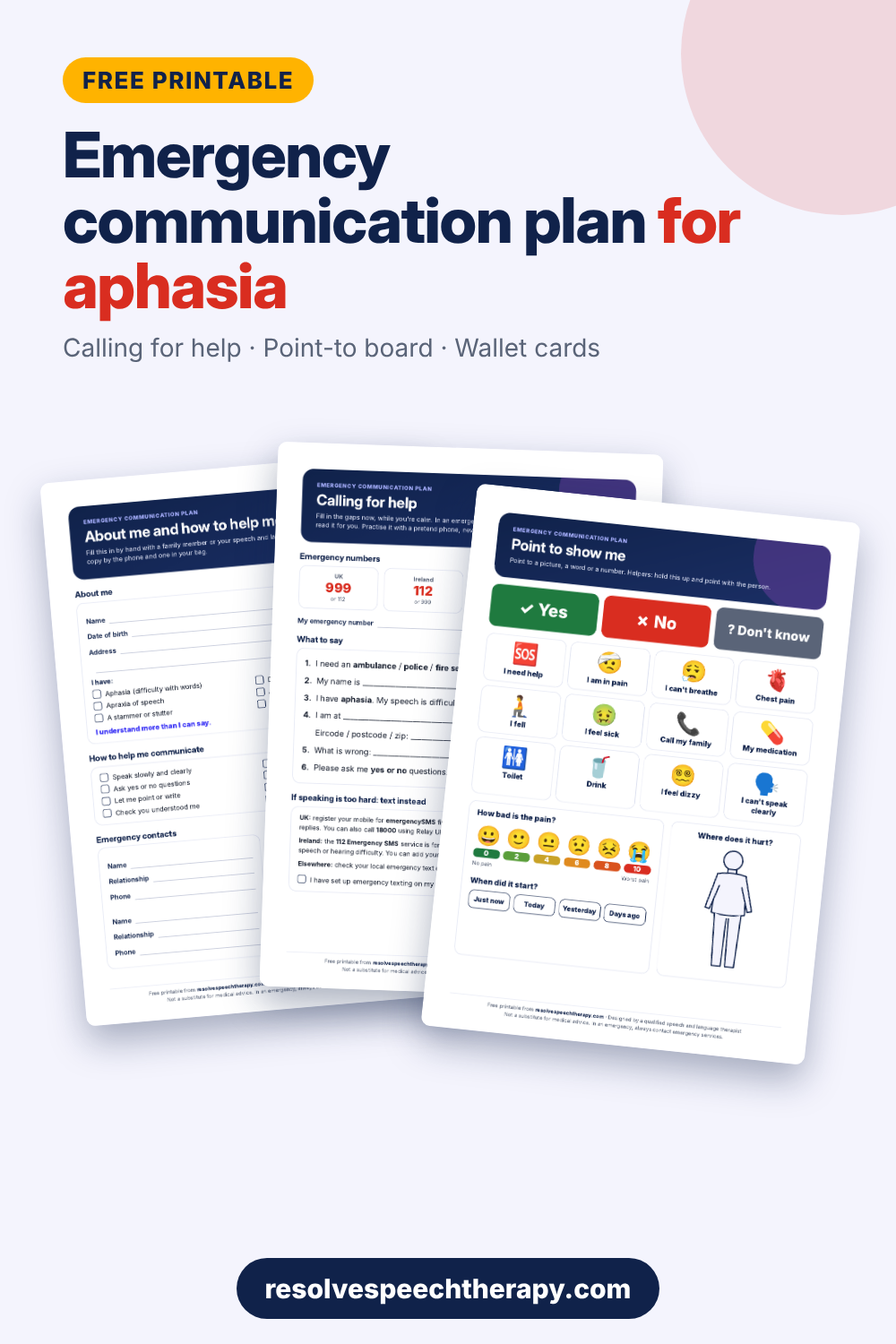
In an emergency, everyone needs to get the right message across, fast. For someone with aphasia or another speech difficulty, that can feel impossible under stress. An emergency communication plan, made in advance while everyone is calm, can make all the difference. Below is what to include, how to practise it safely, and a free 4-page printable to fill in today.
Why emergencies are harder when talking is hard
Aphasia affects language, not intelligence. Many people with aphasia know exactly what they want to say but can't find or produce the words, especially when they are stressed, tired or rushed. An emergency is all three.
On a phone call there are no gestures, pictures or facial expressions to help. The person on the other end may not know the caller has a communication difficulty. Speech may be mistaken for confusion or intoxication.
A plan helps in three ways. It gives the person words to read out or point to. It tells others how to help them communicate. And it means the important details, like contacts, address and health information, are already written down.
What to include: the 4 parts of the free printable
About me and how to help me. Name, address, the type of communication difficulty, and a clear line: "I understand more than I can say." Then simple tick boxes for how to help: speak slowly, ask yes or no questions, give me time, let me point or write. Add emergency contacts and key health information, like conditions, allergies and where the medication list is kept.
Calling for help. A fill-in-the-gaps script to read out on the phone: which service is needed, my name, "I have aphasia, my speech is difficult", my address and postcode or Eircode, and what's wrong. It also lists the emergency numbers and texting options: 999 and 112 in the UK and Ireland version, and 911 in the USA version.
Point to show me. A board with Yes, No and Don't know, 12 picture tiles (I need help, I'm in pain, I can't breathe, chest pain, I fell, call my family and more), a 0 to 10 pain scale, "When did it start?" and a body outline to point to where it hurts.
Wallet cards. Cut-out cards that say "I have a communication difficulty" on one side, with emergency details on the other, to keep in a wallet or phone case.
Fill it in by hand, ideally with a family member or speech and language therapist. Keep one copy by the phone, one in a bag, and a card in a wallet.
Practising calling for help, safely
A script only helps if it feels familiar. Practise it a few times, a little like a fire drill:
Use a pretend phone. An old switched-off phone, a toy phone or a picture of one. Never dial the real emergency number to practise.
Read the script aloud together, then let the person try it on their own.
Role-play the other side. A family member plays the operator and asks simple questions: "Which service?", "What's your address?", "Is the person breathing?"
Practise pointing. Use the point-to board to answer questions without speaking.
Repeat it every few weeks, so it stays easy to find and use under stress.
Texting emergency services in the UK, Ireland and the US
If speaking is too hard, some countries let you text emergency services instead. Set it up before you need it.
UK: register for emergencySMS by texting the word register to 999, then following the replies. You must register first. You can also contact 999 through Relay UK by calling 18000 (Relay UK).
Ireland: the 112 Emergency SMS service can be used by anyone who can't make a voice call because of a speech or hearing impairment. You can add your details on the 112.ie site.
Elsewhere: check what your local emergency services offer, and set it up now. In the US, text to 911 is available in many, but not all, areas. If it isn't available where you are, you'll get an automatic reply telling you to contact 911 another way. Check with your local 911 centre or your state's 911 website.
Texting is slower than calling, so if a voice call is possible, a call is usually faster.
Always check it works first. Emergency services and the ways to contact them can change, and they vary by area. Before relying on any of these options, check with your speech and language therapist or your local emergency services that they work where you live. Clinicians: please confirm the current options in your area before sharing the plan.
Tips for families, and for SLTs
For families
Make the plan with the person, not for them. They decide what goes on it.
Keep it where it's easy to grab: by the phone, on the fridge, in a bag.
Update it when contacts, medications or address change.
Carry a wallet card when out. Aphasia ID cards can help explain a communication difficulty to first responders and medical staff, as the National Aphasia Association notes.
For speech and language therapists
Filling in the plan makes a meaningful, functional session, and families can join in.
Practising the phone script and point-to board can become a functional goal, such as calling for help using a script with minimal cues.
Send it home as practice between sessions.
Download your free emergency communication plan
4 printable pages, in a UK and Ireland version (A4) and a USA version (US Letter): About me and how to help me, Calling for help, Point to show me, and Wallet cards.
Enter your email below, and your download buttons will appear straight away.
[In Squarespace: add a Newsletter block here, then a Code block with blog-download-gate.html, and paste your two PDF links into it. Delete this note.]
Want more? Explore step-by-step home practice for aphasia, dysarthria, apraxia of speech, voice and stuttering at resolvespeechtherapy.com, or try the free aphasia practice plan.
This resource supports, and does not replace, individual advice from your healthcare professionals. In an emergency, always contact emergency services.
Sources
Emergency SMS service, 112.ie
Aphasia ID card and other identification, National Aphasia Association
Enter your email and the download buttons will appear straight away.
🎉 Thank you! Your free printable is ready: